
Your Triggers Are Not Weaknesses — They’re Signals Worth Understanding.
Hello, Mindful Recovery Hub community! 💙
Have you ever been doing okay… and suddenly:
- A smell
- A place
- A stressful day
- A text from someone
- A memory
…hits you like a wave?
And before you know it, cravings, anxiety, or emotional overwhelm show up out of nowhere.
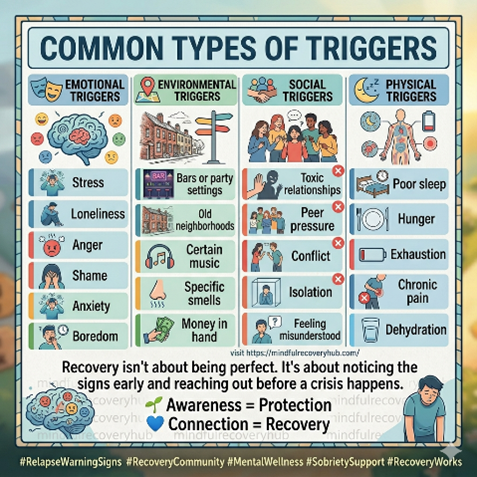
That’s called a trigger and understanding your triggers is one of the most powerful relapse prevention tools in recovery.
The good news? Triggers do not control you.
But learning them can protect you
🧠 What Is a Trigger?
A trigger is anything that activates:
⚠️ Cravings
⚠️ Emotional distress
⚠️ Urges to use
⚠️ Negative coping patterns
And sometimes… they’re sneaky.
💡 DID YOU KNOW?
Your brain connects memories, emotions, and survival experiences together.
That means even small things like a song or stressful conversation can unconsciously activate old coping patterns.
Triggers are not “attention-seeking.”
They are nervous system responses.
📖 A Quick Recovery Story
Marcus had 8 months sober.
One afternoon, he drove past a gas station he used to stop at during active addiction. Suddenly, his chest tightened. Cravings hit hard.
At first, he thought:
“What’s wrong with me?”
But nothing was wrong.
His brain had simply associated that location with relief, escape, and habit.
Instead of using, Marcus:
- Called a friend
- Changed his route
- Ate dinner
- Attended a virtual support meeting
The craving passed.
The trigger didn’t disappear overnight but his response changed.
And that’s recovery!
🚨 Common Relapse Warning Signs Connected to Triggers
Sometimes triggers quietly build before relapse happens.
Watch for:
- Romanticizing past substance use
- Increased irritability
- Skipping recovery meetings
- Emotional numbness
- Isolating from support
- Saying “I got this” while secretly struggling
- Ignoring stress or mental health symptoms
The earlier you notice the signs, the stronger your response can be.
Results:
🟢 0–1 YES: Great awareness keep strengthening your coping tools.
🟡 2–3 YES: You may benefit from building a stronger trigger management plan.
🔴 4–5 YES: It may be time to reconnect with support, therapy, meetings, or recovery tools more intentionally.
🌱 What To Do When Triggered
Here’s the important part:
You do not need to panic every time you’re triggered.
You need a plan.
🛠 Trigger Survival Toolkit
✅ Pause Before Reacting
- Cravings rise and fall like waves.
- Give yourself time.
✅ HALT Check. Ask yourself: Am I:
- Hungry?
- Angry?
- Lonely?
- Tired?
These four states increase vulnerability fast.
✅ Reach Out. Connection interrupts isolation.
- Text someone.
- Join a meeting.
- Talk honestly.
✅ Change the Environment
Sometimes healing looks like leaving early, taking a different route, or muting a number.
Protecting your peace is recovery work.
✅ Practice Grounding
Try:
- Deep breathing
- Cold water on your hands
- Naming 5 things you see
- Walking outside
Ground your nervous system first.
Problem-solve second.
💡 DID YOU KNOW?
Most cravings peak and fade within about 20–30 minutes if you do not feed them.
Feelings are temporary.
Urges are survivable.
🌿 Person-Centered Reminder
Having triggers does not mean you’re failing recovery.
It means you’re healing from something real.
Your brain learned survival patterns over time.
Recovery means learning new ones with compassion not shame.
You are not “too broken.”
You are becoming more aware.
And awareness is powerful.
💬 Final Reflection
Ask yourself today:
👉 “What situations, emotions, or people tend to pull me away from the version of myself I’m trying to become?”
Not to judge yourself.
But to understand yourself.
Because understanding your triggers isn’t about fear.
It’s about freedom. 💙
With care,
Dami @ Mindful Recovery Hub